No. 050
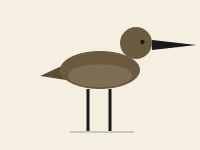
Common Snipe
Gallinago gallinago
扇尾沙锥
- Scientific name
- Gallinago gallinago
- Order
- Charadriiformes
- Family
- Scolopacidae
- Length
- 25–27 cm
- Wingspan
- 44–47 cm
- Habitat
- wet meadows, rushy pasture, marsh edges, soft mud by pools
- Range
- northern Europe and Asia, wintering south to Africa and South Asia
- Diet
- earthworms, insect larvae, small crustaceans, seeds
Identification
A small, compact wader built for concealment: 25–27 cm long, with an extremely long, straight bill, short greenish-grey legs, and plumage of dark brown and black cut by buff and cream stripes running the length of the back. The head is striped too, with a pale crown stripe and a dark eye-stripe, and the eye sits far back in the skull — useful, because with the bill buried in mud the bird's binocular vision is pushed backwards to watch for danger. It differs from Jack Snipe by the longer bill, the pale crown stripe and the white trailing edge to the wing. When the tail is fanned it shows rufous and black barring.
Snipe feed by rhythmically pumping the long bill vertically into soft mud, probing by touch for earthworms, insect larvae and small crustaceans; the flexible bill tip can open before the base does, gripping prey underground. On the ground they are famously elusive, sitting tight on camouflage and then bursting up at close range in a zigzagging flush with a rasping 'scaap'. The spring display is stranger still: the 'drumming' is not a call at all but the sound of the outer tail feathers vibrating as the bird dives through the air, a bleating note that carries right across the marsh.
Look for them in wet meadows, rushy pastures, marshy field corners and soft mud at the edge of pools, especially in winter and on migration. Damp stubble and flooded grassland after rain are good bets. Because they sit until almost stepped on, walk slowly into the wind and watch the ground a few metres ahead; the drumming is best heard at dusk in spring.
Voice
a rasping 'scaap' when flushed; a bleating 'drumming' in display