No. 029
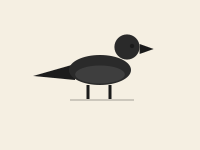
Common Blackbird
Turdus merula
乌鸫
- Scientific name
- Turdus merula
- Order
- Passeriformes
- Family
- Turdidae
- Length
- 24–27 cm
- Wingspan
- 34–38 cm
- Habitat
- gardens, parks, woodland, hedgerows, city squares with grass
- Range
- Europe, North Africa, South Asia; introduced in Australia and New Zealand
- Diet
- earthworms, insects, fallen fruit and berries
Identification
A large ground-feeding thrush of 24–27 cm, the Common Blackbird is strongly dimorphic. The male is matt black with a bright yellow-orange bill and a yellow eye-ring framing a dark eye; the female is dark brown with a paler, faintly streaked throat and breast and a duller brownish bill. In flight the wings look broad and rounded and the tail long, and a low chattering alarm call usually gives the bird away before it breaks from cover.
Blackbirds feed mostly on the ground, hopping forward a few paces, stopping to stare, then flicking leaf litter aside or pulling at a worm until it comes free. Fruit dominates in autumn and winter — fallen apples and berries especially — and a single laden tree can hold a dozen squabbling birds. Breeding starts in March in mild years, with a neat cup of grass and mud tucked into ivy, hedge or shrub and up to three broods, and the song, a relaxed fluting series of phrases each repeated two or three times, is the backbone of the spring dawn chorus, delivered from a rooftop or treetop perch.
Parks, gardens, allotments and even city squares with a strip of grass hold birds year-round. Look on the lawn after rain, or simply listen at first light from March to June and again on mild autumn mornings. Where blackbirds are tame, sitting still with a few sultanas or chopped apple on the ground brings them in within minutes.
Voice
a relaxed, fluting series of phrases, each repeated two or three times