No. 020
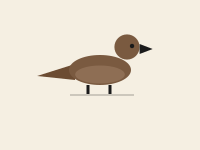
Common Nightingale
Luscinia megarhynchos
夜莺
- Scientific name
- Luscinia megarhynchos
- Order
- Passeriformes
- Family
- Muscicapidae
- Length
- 15–16.5 cm
- Wingspan
- 20–23 cm
- Habitat
- dense scrub, overgrown hedges, coppice, nettle beds
- Range
- Europe, North Africa and Central Asia; winters in tropical Africa
- Diet
- beetles, ants and other insects; berries in autumn
Identification
The Common Nightingale is a plain, skulking bird with no field marks to spare: 15–16.5 cm of warm mid-brown above, the tail fractionally more rufous than the back, and pale grey-buff underparts with a softly mottled breast and buffy flanks. The eye is large and dark, the bill thin and slightly darker, and unlike the red-breasted chats it shows colour nowhere on the body. Its closest look-alike, the Thrush Nightingale, is slightly colder grey with faint dark spotting on the upper breast and is best separated by voice and range.
Its fame rests entirely on the song: an unhurried series of rich, fluting whistles, a churring crescendo, and a ringing 'lu-lu-lu' finale, delivered from deep cover with far more invention than a blackbird's repeated phrase. Unpaired males sing through the night, which is the source of the bird's literary reputation, and the sound carries much further than the singer can be seen. Nightingales feed on the ground on beetles and ants, take berries in autumn before migrating to tropical Africa, and place a plain cup nest low in nettles or bramble.
Go in April and May, at dawn and again after dusk, and look for dense scrub, overgrown hedges, coppice and nettle beds — especially a thick tangle at knee height with bare ground nearby. Approach quietly and watch the base of the thicket: a bird will sometimes hop onto a low bare twig to sing a few phrases, then drop straight back out of sight.
Voice
rich fluting whistles building to a churring crescendo and a ringing 'lu-lu-lu' finale