No. 040
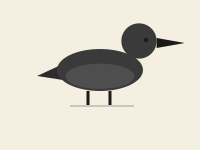
Common Guillemot
Uria aalge
崖海鸦
- Scientific name
- Uria aalge
- Order
- Charadriiformes
- Family
- Alcidae
- Length
- 38–45 cm
- Wingspan
- 64–73 cm
- Habitat
- sea cliffs and rocky stacks; open sea outside the breeding season
- Range
- North Atlantic and Arctic coasts; largest numbers around Britain, Iceland and Norway
- Diet
- sand eels, sprats, capelin and other small fish
Identification
The Common Guillemot is a slim, upright auk with a chocolate-brown back and head, crisp white underparts and a long, pointed black bill. It stands like a small penguin on the cliff ledge and, unlike the Puffin, has no colourful display — its plumage is understated and uniform. A small proportion of birds, more in northern colonies, show the 'bridled' form: a white ring around the eye with a thin white line curving back across the cheek. Autumn juveniles are smaller, with a white throat and a darker face. The similar Razorbill has a thicker, blunt bill with a white stripe; the two often share the same ledges.
Guillemots are among the deepest-diving birds in the Atlantic, using their wings to swim and reaching depths of over a hundred metres on a single breath. They feed on sand eels, sprats and small fish and, like puffins, may hold several fish crosswise in the bill. Breeding is a scramble for space: thousands of pairs pack onto narrow ledges with no nest at all, each bird incubating its single egg on its feet. The egg is pear-shaped and rolls in a tight circle, which stops it tumbling off the ledge. Chicks leave the colony at about three weeks old, before they can fly, launching off the cliff and gliding down to a waiting father at sea — a leap known as 'jumpling'.
Sea-cliff colonies are the way to see them, and Britain and Ireland hold the bulk of the European population — Bempton Cliffs, the Farne Islands, Handa and Skomer are all reliable. The season runs from late spring, when birds return to the ledges, through midsummer when the chicks jump. Because the birds crowd shoulder to shoulder, a single scan with a telescope can show hundreds at once; look for bridled individuals tucked among the common form. Guillemots are silent and business-like compared with the gulls around them, and that quiet presence is part of the cliff's character.
Voice
a growling 'arr' at the colony; otherwise quiet