No. 049
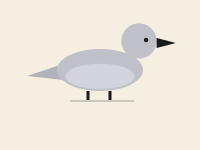
Black-legged Kittiwake
Rissa tridactyla
三趾鸥
- Scientific name
- Rissa tridactyla
- Order
- Charadriiformes
- Family
- Laridae
- Length
- 37–43 cm
- Wingspan
- 91–110 cm
- Habitat
- sea cliffs and offshore stacks; strictly pelagic in winter
- Range
- North Atlantic and North Pacific; large colonies in Britain, Iceland and Norway
- Diet
- small fish, plankton, crustaceans and fishery waste taken at the surface
Identification
The Black-legged Kittiwake is the daintiest of the common gulls: a small, soft-looking bird with a white head, pearl-grey back and neat black wingtips that look as if they have been dipped in ink. The bill is yellow and the legs and feet are black — a feature that stands out at a colony and gives the species its name. Its eyes are dark, set in a gentle, rounded face, and in flight the wings are long and slightly bowed. Outside the breeding season it is a bird of the open ocean and is rarely seen from shore. Juveniles are a striking mix of black-and-white wing patterning with a black collar, quite unlike the neat adult.
Kittiwakes feed at the surface, dipping down to snatch fish, plankton and offal without the deep plunge of a gannet; they often gather in flocks over upwellings and tidal fronts, and will follow fishing boats and feeding whales. The name comes from their ringing call, a repeated 'kitti-waake' that fills the cliffs in summer. They nest on the narrowest of ledges, gluing a cup of seaweed and mud to the rock; the nest often looks precarious but is firmly fixed. Pairs raise one to three chicks, and unlike most gulls they are strictly marine in winter, dispersing far out into the North Atlantic.
Cliffs are the place: kittiwakes pack onto sea-facing ledges, and Bempton Cliffs, Flamborough Head and Dunstanburgh in Britain host large numbers, as do Iceland and Norway. Late spring and early summer are best, when the birds are loudest and the colonies at their busiest. Look for them sitting on ledges or swirling in tight flocks along the cliff face, and listen for the call that gives them their name. Because they spend winter far offshore, a close view is a summer privilege — come autumn they vanish to the open sea.
Voice
the ringing 'kitti-waake' call that names the bird