No. 031
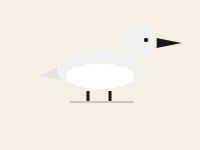
Northern Gannet
Morus bassanus
北鲣鸟
- Scientific name
- Morus bassanus
- Order
- Suliformes
- Family
- Sulidae
- Length
- 87–100 cm
- Wingspan
- 165–180 cm
- Habitat
- open ocean; steep sea cliffs and rocky islands for breeding
- Range
- North Atlantic, from eastern Canada through Iceland and Britain to Norway
- Diet
- mackerel, herring, sand eels and other shoaling fish
Identification
An adult Northern Gannet is a large, sleek white bird with black wingtips and a creamy, butter-yellow wash over the head and nape that deepens in the breeding season. The bill is pale blue-grey with bold black lines tracing the edges of the mandibles, and there is bare black skin around the eye and at the throat. Juveniles are wholly different — dark brown, heavily speckled with white — and take four to five years to reach adult white. In shape the gannet is unmistakable: long, pointed wings, a wedge-shaped tail and a stout, dagger-like bill. It is the largest seabird breeding in the North Atlantic.
Gannets are the North Atlantic's great plunge-divers. A hunting bird circles high, folds into a narrow arrow and drops from up to thirty metres, hitting the water at close to a hundred kilometres an hour. Air sacs in the face and chest cushion the impact, and the bird can chase fish twenty metres down before surfacing to swallow. They feed on mackerel, herring and sand eels, often driving shoals up in loose cooperation with other seabirds. Gannets nest in dense, noisy colonies — Bass Rock in Scotland is the world's largest, with tens of thousands of pairs packed beak-to-tail — and each pair raises a single chick on a nest of seaweed and guano.
Colonies are the place to see them, and several are within easy reach: Bass Rock and Bempton Cliffs in Britain, Bonaventure Island in Quebec, and Eldey off Iceland. The spectacle peaks from May to July, when the cliffs are white with sitting birds and the air is full of incoming adults. A boat trip gives the most dramatic views, but a clifftop viewpoint works too if you have patience and a steady pair of binoculars — watch for the wings-back plummet, the most recognisable feeding dive of any European seabird.
Voice
a harsh, guttural 'grrr' and clicking at the colony