No. 032
Eurasian Oystercatcher
Haematopus ostralegus
蛎鹬
- Scientific name
- Haematopus ostralegus
- Order
- Charadriiformes
- Family
- Haematopodidae
- Length
- 40–45 cm
- Wingspan
- 80–86 cm
- Habitat
- estuaries, rocky shores, sandy beaches, inland gravel pits, arable fields
- Range
- coasts of Europe and Asia; northern birds winter further south
- Diet
- mussels, cockles, limpets, earthworms, insect larvae
Identification
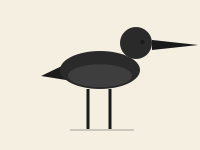
Unmistakable when seen well: a large, stocky shorebird with glossy black head, breast and upperparts, a clean white belly, and a white wing bar that shows as a broad stripe in flight. The bill is long, straight and blade-like — orange-red in adults, duller and more tapered in juveniles — and the eye is red with an orange-red ring. The legs are sturdy and pink. Only the name lets it down: it eats far more than oysters.
Oystercatchers specialise in opening bivalves, but the technique differs between individuals and even between neighbouring populations. Some birds hammer a hole in the shell; others prise the two valves apart at the seam. These are learned traditions, passed from parent to chick, and the two specialists can forage side by side on the same mussel bed. On grassland and arable fields the same birds switch to probing for earthworms; on rocky shores they take limpets and winkles. They nest in a shallow scrape on shingle, sand or bare arable fields, sometimes in loose colonies, and defend the site with a loud piping display flight.
Coastal winter is prime time, when hundreds gather on estuaries and rocky shores, roosting on the highest rocks at high tide. Listen for the piercing, carrying 'kleep' and pick out the black-and-white bird with the orange bill. Inland gravel pits and wet meadows have become increasingly good in recent years, so check likely fields in spring as well.
Voice
a piercing, piping 'kleep', often in flight