No. 036
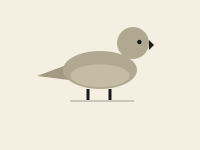
Eurasian Collared Dove
Streptopelia decaocto
灰斑鸠
- Scientific name
- Streptopelia decaocto
- Order
- Columbiformes
- Family
- Columbidae
- Length
- 31–33 cm
- Wingspan
- 47–55 cm
- Habitat
- gardens, farmyards, villages, suburbs
- Range
- Europe, Asia, North Africa; introduced in North America and Japan
- Diet
- grain, seeds, buds, insects
Identification
The Eurasian Collared Dove is a pale, sandy-grey bird with a small head, a short dark bill and one diagnostic feature: a narrow black half-collar wrapped around the back of the neck, which gives the species its name. The tail is square-ended and shows a broad white base from below, and the eye is a striking dark red. It is slimmer and paler than a Wood Pigeon, and plainer than a Turtle Dove — there is no scaling on the back and no white on the wing.
The call is remarkably insistent: a three-note phrase with the middle note hammered out hardest, repeated over and over from a rooftop, wire or television aerial. The species associates closely with people, nesting on buildings, in garden conifers and on ledges, laying two white eggs and sometimes raising as many as six broods in a year. It is also one of the great natural colonisers of modern times: from a base in the Balkans it spread west across Europe from the 1930s, reaching Britain in the 1950s, and turned up in the Bahamas and then Florida in the 1980s, from where it has swept across North America.
Villages, farmyards, suburban gardens and feeders are all reliable places to look, and the bird is resident year-round, so any month will do. The easiest approach is to learn the three-note call first and then scan the wires — the pale body and black neck collar will confirm it instantly. Watch for it on the ground beneath feeders, where it picks up spilt grain.
Voice
a three-note 'coo-COO-cuk' with a heavy middle beat